JEE MAIN 2019 · 10 APR S1+4 / −1MEDIUMTRANSCRIBED
JEE Main 2019 Chemistry question — Quantum mechanical model, wave function and probability
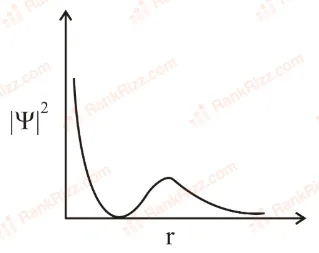
The graph between and r (radical distance) is shown below. This represents:
SOLUTION
- For an s-orbital, the radial wave function has a maximum, non-zero value at the nucleus.
- For p, d, and f orbitals, the wave function value at the nucleus is always zero because of the angular nodes
- Looking at the graph, the curve starts at a very high value on the y-axis when r = 0, meaning it must be an s-orbital.
2. Finding the Number of Radial Nodes
- A radial node is a region in space where the probability of finding an electron drops exactly to zero..
- In the given graph, the curve touches the x-axis exactly once before rising again and gradually tapering off to infinity.
- Therefore, the number of radial nodes = 1.
3. Determining the Principal Quantum Number
The formula to calculate the number of radial nodes for any given orbital is:
Radial Nodes = n - l - 1
Where:
- n = Principal quantum number
- l = Azimuthal quantum number (for an s-orbital, )
Substituting our known values into the equation:
1 = n - 0 - 1 = 2
Tagged Quantum mechanical model, wave function and probability. Machine-assigned, so read it as a strong shortlist rather than a verdict.