JEE Main 2019 Chemistry question — Diazonium salts
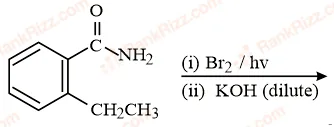
The major product of the following reaction is:
SOLUTION
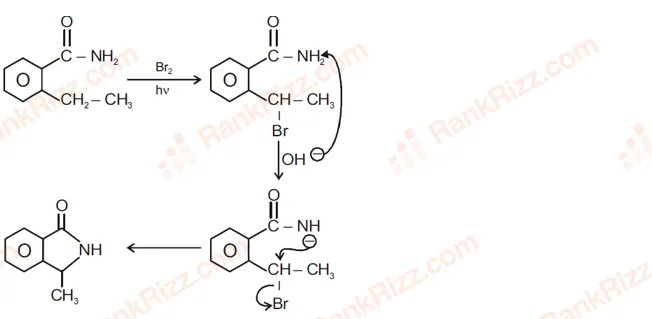
We need to determine the major product of the given reaction sequence involving a free-radical bromination followed by an intramolecular cyclization.
Step-by-Step Reaction Mechanism:
-
Step 1: Free-Radical Bromination ()
When the starting ethylbenzene derivative is treated with bromine in the presence of light (), free-radical substitution occurs selectively at the more stable benzylic position. This replaces one benzylic hydrogen atom with a bromine atom, forming a secondary benzylic bromide intermediate:
-
Step 2: Deprotonation by Base ()
The addition of hydroxide ion () acts as a base to abstract the acidic proton from the primary amide nitrogen group (). This generates a strongly nucleophilic amidate anion intermediate:
-
Step 3: Intramolecular Cyclization (Ring Closure)
The negatively charged nitrogen atom () undergoes a rapid, favorable intramolecular nucleophilic substitution () by attacking the adjacent benzylic carbon bearing the bromine atom, displacing the bromide leaving group ():
This ring closure constructs a stable, six-membered nitrogen-containing heterocyclic ring (a lactam framework) fused directly to the benzene core with a methyl group remaining at the newly closed carbon junction.
Conclusion:
The reaction sequence smoothly converts the ortho-substituted ethylbenzamide into a fused six-membered cyclic amide carrying a methyl substituent via regioselective benzylic bromination and subsequent intramolecular displacement.
Answer: Option B
Tagged Diazonium salts. Machine-assigned, so read it as a strong shortlist rather than a verdict.