JEE MAIN 2020 · 07 JAN S2+4 / −1MEDIUMTRANSCRIBED
JEE Main 2020 Chemistry question — Diazonium salts
In the following reaction sequence,
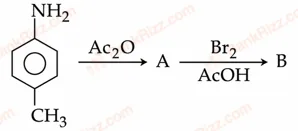
the major product B is
SOLUTION
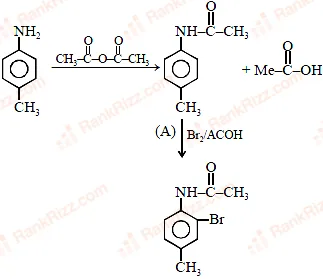
We need to determine the major product B formed in the given reaction sequence starting from p-toluidine.
Step-by-Step Reaction Mechanism:
-
Step 1: Acetylation (Formation of Compound A)
When p-toluidine (4-methylaniline) reacts with acetic anhydride (), the amino group () undergoes acetylation. This converts the strongly activating amino group into a moderately activating acetamido group ():
This protection step softens the reactivity of the nitrogen lone pair, preventing multiple halogenations.
-
Step 2: Electrophilic Monobromination (Formation of Product B)
Compound A is then treated with bromine in acetic acid ():
- Both the group and the group are ortho/para-directing.
- The para-position relative to both groups is completely blocked.
- Since the acetamido group () is a significantly stronger activating group than the alkyl group () due to resonance ( vs ), the incoming electrophile () is directed to the position ortho to the group.
Tagged Diazonium salts. Machine-assigned, so read it as a strong shortlist rather than a verdict.