JEE Main 2023 Chemistry question — Electrophilic substitution of aniline
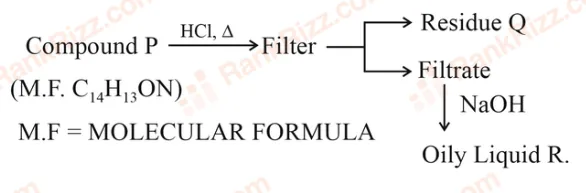
Compound P is neutral, Q gives effervescence with NaHCO while R reacts with Hinsberg's reagent to give solid soluble in NaOH. Compound P is
SOLUTION
Step 1: Calculating the Double Bond Equivalent (DBE)
The Double Bond Equivalent (also known as the Index of Hydrogen Deficiency) tells us the total number of rings and/or -bonds present in the molecule. The general formula for a compound with the molecular formula is:
Substituting the values from the given molecular formula ():
A DBE value of 9 strongly indicates the presence of:
- Two benzene rings: Each benzene ring accounts for 4 structural units (1 ring + 3 double bonds), totaling units of unsaturation.
- One carbonyl or amide group: The remaining 1 unit of unsaturation () corresponds to a double bond, specifically a carbonyl/amide carbon-oxygen double bond ().
Step 2: Deducing the Functional Groups from Chemical Tests
-
Neutral Nature of Compound P:
Compound P is described as neutral. Since it contains a nitrogen atom and an oxygen atom but lacks acidic or basic traits, it points directly toward a substituted amide group () rather than a free amine or carboxylic acid.
-
Acidic Hydrolysis of Amides:
When an amide is heated with dilute hydrochloric acid (), it undergoes cleavage into a carboxylic acid and an amine salt:
-
Analysis of Residue Q:
Residue Q gives brisk effervescence when treated with sodium bicarbonate (), liberating carbon dioxide () gas. This test is a hallmark confirmation for the presence of a carboxylic acid group ().
-
Analysis of Oily Liquid R (Hinsberg Test):
Oily liquid R reacts with Hinsberg's reagent (benzenesulfonyl chloride, ) to produce a solid sulfonamide compound that dissolves readily in aqueous sodium hydroxide (). This specific solubility profile proves that R must be a primary amine ( marketing as ), as its sulfonamide derivative still contains an acidic hydrogen on the nitrogen atom.
Step 3: Reconstructing Compound P
Since the hydrolysis fragments are a carboxylic acid and a primary amine, the parent structure P is a secondary amide linking two aromatic rings:
Let's verify the atom count for this structure:
- Carbons: 7 from the 4-methylbenzoyl part + 6 from the aniline ring = 14 carbons.
- Hydrogens: 7 from the tolyl fragment + 1 from the amide nitrogen + 5 from the phenyl ring = 13 hydrogens.
- Heteroatoms: 1 Oxygen and 1 Nitrogen.
The total formula is precisely , fitting every physical parameter and chemical constraint perfectly.
Conclusion:
The combination of a calculated DBE of 9, its neutral nature, and the formation of a carboxylic acid along with a primary amine upon acid hydrolysis identifies compound P as N-(4-methylphenyl)benzamide / 4-methyl-N-phenylbenzamide.
Answer: The option displaying the structure with a 4-methylphenyl ring on one side and a phenyl group attached to the amide nitrogen ().
Tagged Electrophilic substitution of aniline. Machine-assigned, so read it as a strong shortlist rather than a verdict.