JEE MAIN 2026 · 05 APR S1+4 / −1MEDIUMTRANSCRIBED
JEE Main 2026 Chemistry question — Diazonium salts
Benzyl isocyanide can be obtained from:
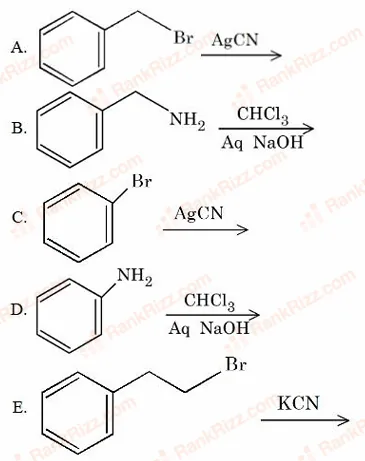
Choose the correct answer from the options given below:
SOLUTION
Reaction A (Correct)
- Reactants: Benzyl bromide () + Silver cyanide ()
- Mechanism: Silver cyanide () is covalent in nature. Because the bond is strong, the lone pair on the nitrogen atom acts as the nucleophile rather than the carbon atom. This nucleophilic substitution () yields an isocyanide.
- Product: Benzyl isocyanide ()
Reaction B (Correct)
- Reactants: Benzylamine () + Chloroform () + aq.
- Mechanism: This is the Carbylamine reaction (Hofmann's isocyanide test). The primary amine reacts with chloroform in a basic medium via a dichlorocarbene () intermediate to form an isocyanide.
- Product: Benzyl isocyanide ()
Reaction C (Incorrect)
- Reactants: Bromobenzene () + Silver cyanide ()
- Mechanism: Bromobenzene does not easily undergo nucleophilic substitution under normal conditions due to the resonance-stabilized, partial double-bond character of the bond. Even under drastic conditions, it would yield phenyl isocyanide (), which lacks the required carbon spacer.
Reaction D (Incorrect)
- Reactants: Aniline () + Chloroform () + aq.
- Mechanism: While this also undergoes the Carbylamine reaction, the starting material is an aromatic primary amine without a side-chain carbon.
- Product: Phenyl isocyanide ()
Reaction E (Incorrect)
- Reactants: 2-Phenylethyl bromide () + Potassium cyanide ()
- Mechanism: Potassium cyanide () is ionic, providing free ions where the negatively charged carbon acts as the nucleophile. Furthermore, the starting alkyl chain already has two carbon atoms instead of one.
- Product: 3-Phenylpropanenitrile ()
Correct Option: A and B Only
Tagged Diazonium salts. Machine-assigned, so read it as a strong shortlist rather than a verdict.