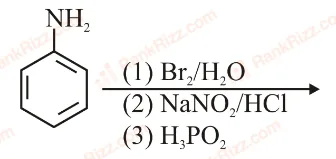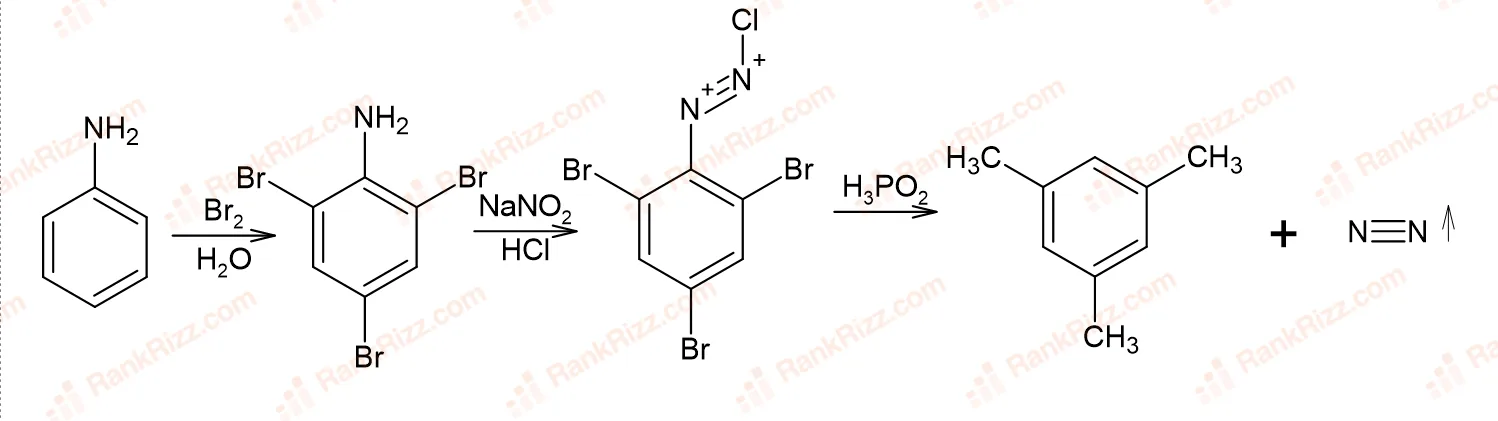
The activating effect is so strong in a polar solvent like water that electrophilic aromatic substitution occurs at all available ortho and para positions simultaneously.
Intermediate 1: 2,4,6-tribromoanilin
Sodium nitrite and hydrochloric acid at low temperatures (0−5∘C).Reaction: This converts the primary aromatic amine group (−NH2) into a stable diazonium salt group (−N2+Cl−)
Hypophosphorous acid (H3PO2) and water.
Reaction: This is a classic reduction reaction where the diazonium group (−N2+) is completely replaced by a hydrogen atom (H), releasing nitrogen gas (N2) and turning H3PO2 into phosphorous acid (H3PO3).
Outcome: The ring loses its nitrogen functional group entirely, leaving behind only the substituted bromine atoms.
Hence, Option C is correct.