JEE MAIN 2025 · 28 JAN S1+4 / −1MEDIUMTRANSCRIBED
JEE Main 2025 Chemistry question — Electrophilic substitution of aniline
Consider the following sequence of reactions:
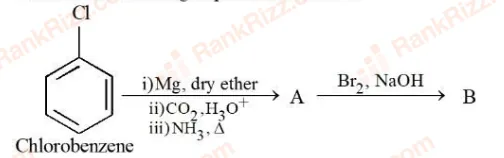
11.25 mg of chlorobenzene will produce __________ of product B . (Consider the reactions result in complete conversion.) [Given molar mass of C, H, O, N and Cl as 12, 1, 16, 14 and respectively]
SOLUTION
Key idea: The Grignard route gives benzoic acid, then benzamide (A). Hofmann bromamide degradation then gives aniline (B), one mole of B for each mole of chlorobenzene.
- (A, benzamide)
- (B, aniline)
- Molar masses: = g mol⁻¹. = g mol⁻¹.
- Moles of chlorobenzene: mmol.
- Mass of aniline: mg.
Answer: 93
Tagged Electrophilic substitution of aniline. Machine-assigned, so read it as a strong shortlist rather than a verdict.