JEE Main 2021 Chemistry question — Diazonium salts
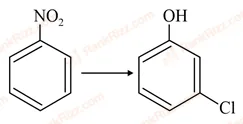
The correct sequence of correct reagents for the following transformation is:-
SOLUTION
The starting material is nitrobenzene and the final product is 3-chlorophenol (-chlorophenol). Since the chlorine atom and the hydroxyl group are in a relationship, the chlorination must be carried out while the group is still present because it is a strong -directing group.
The group is strongly deactivating and directing, whereas both the and groups are strongly activating and directing. Therefore, reducing the nitro group before chlorination would lead predominantly to and substituted products rather than the desired isomer.
The correct sequence is:
- Step 1:
Nitrobenzene undergoes electrophilic aromatic substitution, and the group directs chlorine to the position, giving -chloronitrobenzene. - Step 2:
The nitro group is reduced to an amino group, producing -chloroaniline. - Step 3:
The amino group undergoes diazotization to form -chlorobenzenediazonium chloride. - Step 4: (warm)
Hydrolysis of the diazonium salt replaces the diazonium group with a hydroxyl group, yielding 3-chlorophenol.
The other sequences are incorrect because:
- Option (A): Reduction occurs before chlorination. The resulting group is directing, leading to the wrong products.
- Option (B): Conversion to phenol occurs before chlorination. The group is also directing, so chlorination does not give the required isomer.
- Option (D): Diazotization is attempted directly on a nitro compound. Only primary aromatic amines undergo diazotization, so the nitro group must first be reduced.
Hence, the correct sequence is Option (C).
Tagged Diazonium salts. Machine-assigned, so read it as a strong shortlist rather than a verdict.