JEE Main 2024 Chemistry question — Reactions and tests of amines
Identify B formed in the reaction.
SOLUTION
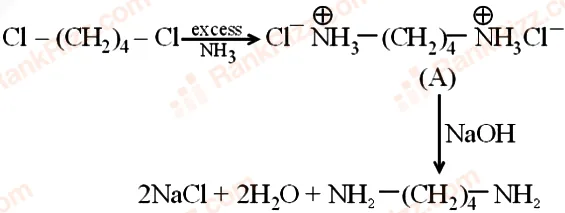
We need to identify the compound formed in the given two-step reaction sequence starting from 1,4-dichlorobutane.
Key Concept: When an alkyl halide reacts with excess ammonia (), it undergoes nucleophilic substitution () to form an amine salt. Treating this salt with a strong base like sodium hydroxide () liberates the free amine.
Step 1: Reaction of 1,4-dichlorobutane with excess ammonia to form intermediate A
In this step, both terminal chlorine atoms of are substituted by ammonia molecules. Because ammonia is used in excess, it prevents further alkylation and yields the corresponding dicationic ammonium salt as intermediate :
Thus, intermediate is butane-1,4-diaminium chloride.
Step 2: Reaction of intermediate A with sodium hydroxide to form B
When the ammonium salt intermediate is treated with , a neutralization reaction takes place. The hydroxide ions () deprotonate the ammonium groups, releasing the free diamine, water, and sodium chloride:
The free amine formed is butane-1,4-diamine (putrescine), which has the structural formula .
Therefore, compound is , which corresponds to Option B.
Answer: Option B —
Tagged Reactions and tests of amines. Machine-assigned, so read it as a strong shortlist rather than a verdict.