JEE Main 2021 Chemistry question — Diazonium salts
Match List - I with List - II:
List - I (Chemical Reaction) List - II (Reagent used)
a. CHCOOCHCH CHCHOH i. CHMgBr/HO (one equivalent)
b. CHCOOCH CHCHO ii. HSO/HO
c. CHCN CHCHO iii. DIBAL-H/HO
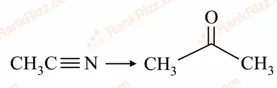
d. iv. SnCl, HCl/HO
Choose the most appropriate match:
SOLUTION
We look at transformation (a). The starting compound is , an ester known as ethyl acetate. The desired product is , ethanol. We recall the general hydrolysis reaction of an ester in acidic medium, which is stated as
$
Here and , so hydrolysis will furnish acetic acid and ethanol. The reagent that supplies both water and acid is the mixture , listed as (ii). Hence, for part (a) we must choose (ii).
Now we examine transformation (b). The substrate is (methyl acetate) and the target is (acetaldehyde). Converting an ester directly to an aldehyde requires partial reduction that stops at the aldehyde stage. The reagent famous for this selective one-step reduction is DIBAL-H followed by aqueous work-up. The overall reaction may be represented as
$
DIBAL-H/HO is option (iii), so (b) corresponds to (iii).
Next, consider transformation (c): . Converting a nitrile to an aldehyde is achieved by the Stephen reduction. The textbook Stephen reduction uses stannous chloride in the presence of hydrochloric acid, followed by hydrolysis:
$
This reagent set is given as (iv) . Therefore, (c) matches (iv).
Finally, we look at transformation (d): , i.e. conversion of acetonitrile to acetone. A single equivalent of a Grignard reagent adds an alkyl group to the electrophilic carbon of the nitrile, giving an imine magnesium salt; hydrolysis of the imine then produces a ketone. The general formula is
$
With and , we indeed obtain . The required reagent is , listed as (i). Thus, (d) corresponds to (i).
Collecting all the matches we have:
$
This sequence appears exactly in Option A.
Hence, the correct answer is Option A.
Tagged Diazonium salts. Machine-assigned, so read it as a strong shortlist rather than a verdict.