JEE Main 2026 Chemistry question — Electrophilic substitution of aniline
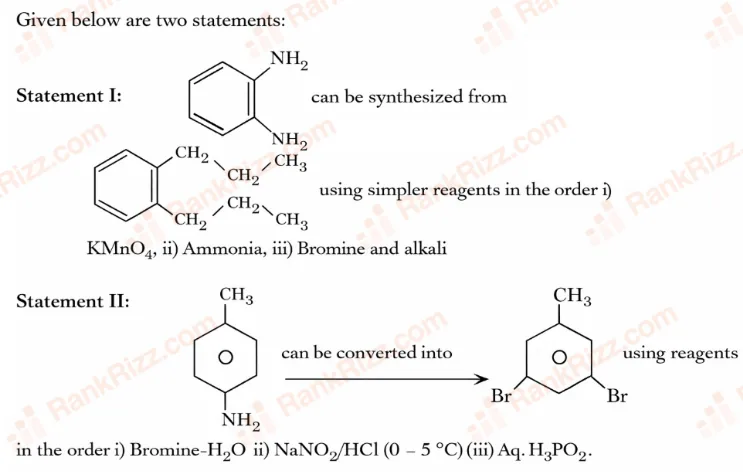
In the light of the above statements, choose the correct answer from the options given below
SOLUTION
We need to evaluate the correctness of two organic reaction sequences presented in Statement I and Statement II.
Statement I:
The first sequence outlines the conversion of tetralin (a bicyclic hydrocarbon where a benzene ring is fused to a 6-membered aliphatic ring) into 1,2-diaminobenzene:
- Step (i) (Oxidation): Vigorous oxidation cleaves the aliphatic ring at the benzylic positions, converting both benzylic carbons into carboxylic acid groups. This yields phthalic acid (benzene-1,2-dicarboxylic acid).
- Step (ii) (Ammonolysis & Heating): Reaction of phthalic acid with ammonia followed by heating forms phthalamide, which undergoes cyclization to give phthalimide.
- Step (iii) (Hoffmann Bromamide Degradation): Phthalimide undergoes Hoffmann degradation, converting the carbonyl-linked nitrogen groups into primary amines, yielding 1,2-diaminobenzene.
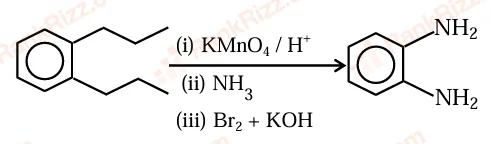
Statement II:
The second sequence outlines the synthesis of 3,5-dibromotoluene starting from 4-methylaniline (p-toluidine):
- Step (i) (Electrophilic Aromatic Substitution): The strongly activating and ortho/para-directing group directs bromine atoms to both of its vacant ortho positions (positions 2 and 6), producing 2,6-dibromo-4-methylaniline.
- Step (ii) (Diazotization): The primary aromatic amine group () is converted quantitatively into a diazonium salt group ().
- Step (iii) \text{aq. } (Deamination): Hypophosphorous acid reduces the diazonium group, replacing it with a hydrogen atom (), which results in the formation of 3,5-dibromotoluene.
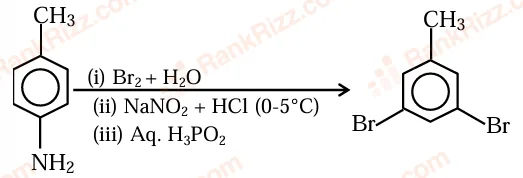
Conclusion:
Both reaction sequences proceed successfully as described to form their respective major products.
Answer: Option C — Both Statement I and Statement II are true
Tagged Electrophilic substitution of aniline. Machine-assigned, so read it as a strong shortlist rather than a verdict.