JEE MAIN 2026 · 22 JAN S1+4 / −1HARDTRANSCRIBED
JEE Main 2026 Chemistry question — Diazonium salts
'A' is a neutral organic compound . On treatment with aqueous , 'A' forms a compound 'B' which is soluble in dilute acid. 'B' on treatment with aqueous produces a compound 'C' which on treatment with produces 'D'. Hydrolysis of 'D' produces 'E' which is also obtainable from the hydrolysis of'A'. 'E' on treatment with acidified produces 'F'. 'F' contains two different types of hydrogen atoms. The structure of 'A' is
SOLUTION
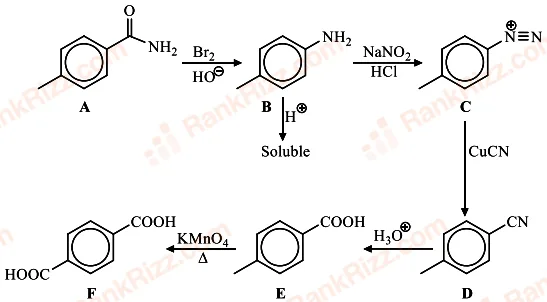
1. Structure A (Hofmann Degradation)
- Reaction Conditions: Compound A has the molecular formula and undergoes a Hofmann bromamide degradation when treated with aqueous . This indicates that 'A' is a primary amide attached to a substituted benzene ring.
- Product B: The amide group () is converted into a primary amine (), yielding 3-methylaniline (m-toluidine), which is basic and soluble in dilute acid.
2. Intermediate Conversions (B C D E)
- Diazotization (B C): Treatment of 3-methylaniline with at converts the amine group into a diazonium salt ().
- Sandmeyer Reaction (C D): Reacting the diazonium salt with replaces the diazonium group with a nitrile group (), forming 3-ethylbenzonitrile.
- Hydrolysis (D E): Complete acid hydrolysis of the nitrile group converts it into a carboxylic acid (), producing 3-methylbenzoic acid. This matches the product obtained from the direct hydrolysis of the amide group in 'A'.
3. Final Oxidation (E F)
- Reaction Conditions: 3-methylbenzoic acid is oxidized using acidified with heating. The side-chain methyl group () undergoes complete oxidation into a carboxylic acid group ().
- Product F: The reaction yields benzene-1,3-dicarboxylic acid (isophthalic acid). Due to its symmetrical meta-substitution, the structure contains two distinct types of aromatic hydrogen atoms.
Tagged Diazonium salts. Machine-assigned, so read it as a strong shortlist rather than a verdict.