JEE Main 2025 Chemistry question — Reactions and tests of amines
The descending order of basicity of following amines is :
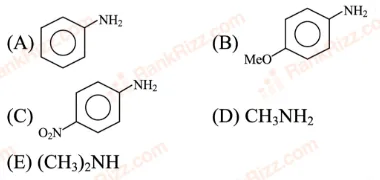
Choose the correct answer from the options given below :
SOLUTION
The basicity of an amine depends on how easily the lone pair on the nitrogen can accept a proton. Greater electron density on N and better stabilization of the resulting ammonium ion both increase basicity.
Important effects that decide electron density on nitrogen are:
(i) Inductive effect ( or ) from alkyl/aryl substituents.
(ii) Resonance (mesomeric) effect ( or ) that may delocalize or donate electron density.
(iii) Hybridisation of the nitrogen (sp in aliphatic > sp in aromatic for basicity).
Case 1: Aliphatic amines
(D) is a primary aliphatic amine.
(E) is a secondary aliphatic amine.
Alkyl groups exhibit a effect. Two alkyl groups in E push more electron density toward N than one alkyl group in D. In aqueous medium, secondary > primary for basicity (tertiary suffers from poor solvation).
Hence .
Case 2: Aromatic amines (anilines)
In aniline, the lone pair on N is partly delocalised into the benzene ring by resonance, making it less available for protonation; therefore aniline is less basic than aliphatic amines.
(A) Aniline - no extra substituent.
(B) p-MeO-Aniline - group shows a strong (electron-donating) effect, increasing electron density on the ring and on N through resonance, so it is more basic than aniline.
(C) p-NO-Aniline - group shows a powerful (electron-withdrawing) effect, withdrawing electron density from the ring and N, thus making the amine much less basic.
Therefore, among the three anilines: .
Combining both sets
Overall descending basicity order becomes:
This matches Option B.
Answer: Option B (E > D > B > A > C).
Tagged Reactions and tests of amines. Machine-assigned, so read it as a strong shortlist rather than a verdict.