JEE Main 2019 Chemistry question — Reactions and tests of amines
A compound 'X' on treatment with Br/NaOH, provided , which gives positive carbylamine test. Compound X' is:
SOLUTION
We notice at once that the reagent combination is the classical Hoffmann bromamide-degradation reagent. The very first fact we recall is the reaction itself:
The two most important points of this reaction are:
1. The product is a primary amine, because the nitrogen still possesses two hydrogens.
2. The carbonyl carbon (the C of the group) is lost as carbonate, so the amine formed has one carbon atom fewer than the original amide.
According to the question, the amine that actually forms has the molecular formula and it gives a positive carbylamine test, so it is indeed a primary amine. Therefore the starting amide must contain exactly one carbon atom more than this, i.e.
So we are looking for a compound with the formula and, crucially, it must contain the functional group (so that it is a primary carboxamide).
Now we examine the four options one by one, keeping these two criteria in mind.
Option A:
This molecule contains a (ketone) group attached to the fragment , making it a secondary amine, not an amide. Hence it cannot undergo Hoffmann degradation in the required manner.
Option B:
Again we have a ketone , this time adjacent to a primary amine. There is no moiety, so Hoffmann degradation is impossible.
Option C:
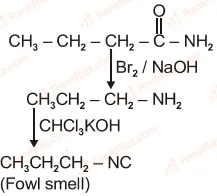
Here the functional group is clearly , so the molecule is an amide, specifically butanamide. Let us count its atoms:
Carbons:
Hydrogens:
Nitrogen:
Oxygen:
Thus the empirical formula is , exactly what we require.
Applying the Hoffmann equation with we obtain
The amine produced is , whose molecular formula is , in complete agreement with the data.
Option D:
This molecule does contain a carbonyl attached to nitrogen, but the nitrogen bears no hydrogen; it is a tertiary amide. Hoffmann degradation strictly requires an group on the carbonyl carbon, so this option is ruled out.
Among all the given structures, only Option C satisfies both the structural requirement (primary amide) and the carbon-count requirement (one carbon more than the amine).
Hence, the correct answer is Option C.
Tagged Reactions and tests of amines. Machine-assigned, so read it as a strong shortlist rather than a verdict.