JEE Main 2023 Chemistry question — Diazonium salts
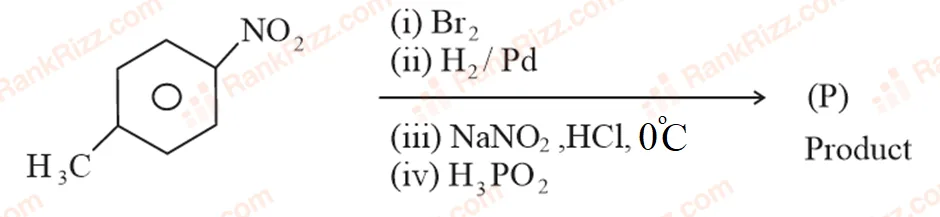
The product (P) formed from the following multistep reaction is:
SOLUTION
Step (i): Bromination ()
When 4-nitrotoluene reacts with , electrophilic aromatic substitution occurs. We must look at the directing influence of both groups to determine where the bromine atom () will attach:
- The group directs incoming electrophiles to its ortho positions (positions 2 and 6 relative to itself).
- The group directs incoming electrophiles to its meta positions (which also happen to be positions 2 and 6 relative to the group).
Because both groups reinforce each other, the bromine atom is introduced ortho to the methyl group and meta to the nitro group.
Step (ii): Reduction ()
Catalytic hydrogenation using hydrogen gas over a palladium catalyst () selectively reduces the strongly electrophilic nitro group () into an amino group (). The ring-bound bromine and methyl groups remain unaffected under these typical conditions.
Step (iii): Diazotization ()
Reacting a primary aromatic amine () with nitrous acid (generated in situ from and ) at a low temperature () converts the amino group into a highly reactive diazonium salt group ().
Step (iv): Deamination ()
Hypophosphorous acid () acts as a mild reducing agent that replaces the diazonium group () with a hydrogen atom (), releasing nitrogen gas (). This effectively removes the original functional group at that position entirely.
Therefore, the final product (P) is 2-bromotoluene (also called o-bromotoluene).
Tagged Diazonium salts. Machine-assigned, so read it as a strong shortlist rather than a verdict.