JEE ADVANCED 2007 · PAPER 2TRANSCRIBED
JEE Advanced 2007 Physics question — Calculus, graphs and approximations used in physics
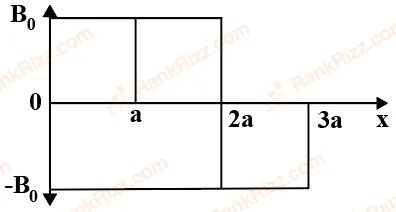
A magnetic field exists in the region a < x < 2a and , in the region 2a < x < 3a, where is a positive constant. A positive point charge moving with a velocity , where is a positive constant, enters the magnetic field at x = a. The trajectory of the charge in this region can be like,
SOLUTION
Key idea: . The force direction sets which way the path curves, and the reversed field in the second region curves it back.
- In $a
- In $2a
- By symmetry, the second region turns the velocity back by the same angle, and the charge leaves moving along , shifted upward in . This is the smooth S-shaped curve rising upward.
- (B) curves the wrong way (towards ). (C) and (D) have a sharp corner at , which is impossible because velocity cannot change suddenly.
Answer: (A)
Tagged Calculus, graphs and approximations used in physics. Machine-assigned, so read it as a strong shortlist rather than a verdict.