RankRizz
JEE ADVANCED 2024 · PAPER 2+4MEDIUMTRANSCRIBED

JEE Advanced 2024 Physics question — Refraction at plane surfaces, Snell's law and apparent depth

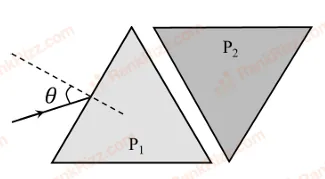
Two equilateral-triangular prisms P1P_1 and P2P_2 are kept with their sides parallel to each other, in vacuum, as shown in the figure. A light ray enters prism P1P_1 at an angle of incidence θ\theta such that the outgoing ray undergoes minimum deviation in prism P2P_2. If the respective refractive indices of P1P_1 and P2P_2 are 32\sqrt{\dfrac{3}{2}} and 3\sqrt{3}, θ=sin⁡−1[32sin⁡(πβ)]\theta = \sin^{-1}\left[\sqrt{\dfrac{3}{2}} \sin\left(\dfrac{\pi}{\beta}\right)\right], where the value of β\beta is ________.

Figure for JEE Advanced 2024 Physics question on Refraction at plane surfaces, Snell's law and apparent depth
SOLUTION

For each equilateral-triangular prism the refracting (apex) angle is A=60∘=π3A = 60^\circ = \dfrac{\pi}{3}.

Step 1: Condition for minimum deviation in prism P2P_2
For minimum deviation in any prism, the path of the ray is symmetrical, so r=r′=A2=30∘r = r' = \dfrac{A}{2} = 30^\circ inside the prism, and the angles of incidence and emergence are equal: i=ei = e.

Applying Snell’s law at the first face of P2P_2 (outside medium is vacuum, n=1n = 1):
sin⁡i=n2sin⁡r\sin i = n_2 \sin r

Given n2=3n_2 = \sqrt{3}, therefore
sin⁡i=3 sin⁡30∘=3(12)=32\sin i = \sqrt{3}\,\sin 30^\circ = \sqrt{3}\left(\dfrac{1}{2}\right)=\dfrac{\sqrt{3}}{2}
so i=60∘=π3i = 60^\circ = \dfrac{\pi}{3}.

Hence the light ray must strike the first face of P2P_2 with an incidence angle of 60∘60^\circ.

Step 2: This same ray is the emergent ray from prism P1P_1
The two prisms are arranged with their corresponding faces parallel; therefore the angle the ray makes with the normal when it leaves P1P_1 is the same 60∘60^\circ. Let that angle of emergence from P1P_1 be e1=60∘e_1 = 60^\circ.

Step 3: Ray path inside prism P1P_1
Let the angles of refraction at the two faces of P1P_1 be r1r_1 and r2r_2. For any prism
r1+r2=A=60∘−(1)r_1 + r_2 = A = 60^\circ \qquad -(1)

Snell’s law at the second face (emergence) of P1P_1:
n1sin⁡r2=sin⁡e1n_1 \sin r_2 = \sin e_1
Given e1=60∘e_1 = 60^\circ and n1=32n_1 = \sqrt{\dfrac{3}{2}}, we get
sin⁡r2=sin⁡60∘n1=3232=22=sin⁡45∘\sin r_2 = \dfrac{\sin 60^\circ}{n_1} = \dfrac{\dfrac{\sqrt{3}}{2}}{\sqrt{\dfrac{3}{2}}} = \dfrac{\sqrt{2}}{2} = \sin 45^\circ
so r2=45∘r_2 = 45^\circ.

Using (1)(1):
r1=60∘−45∘=15∘.r_1 = 60^\circ - 45^\circ = 15^\circ.

Step 4: Incidence angle θ\theta on the first face of P1P_1
Apply Snell’s law at the first face of P1P_1:
sin⁡θ=n1sin⁡r1=32  sin⁡15∘\sin \theta = n_1 \sin r_1 = \sqrt{\dfrac{3}{2}}\;\sin 15^\circ

Since 15∘=π1215^\circ = \dfrac{\pi}{12},
sin⁡θ=32  sin⁡ ⁣(π12).\sin \theta = \sqrt{\dfrac{3}{2}}\;\sin\!\left(\dfrac{\pi}{12}\right).

The question states this result as θ=sin⁡−1 ⁣[32  sin⁡ ⁣(πβ)].\theta = \sin^{-1}\!\left[\sqrt{\dfrac{3}{2}}\;\sin\!\left(\dfrac{\pi}{\beta}\right)\right]. Comparing, we must have πβ=π12⟹β=12.\dfrac{\pi}{\beta} = \dfrac{\pi}{12}\quad\Longrightarrow\quad \beta = 12.

Hence the required value is 12.

Tagged Refraction at plane surfaces, Snell's law and apparent depth. Machine-assigned, so read it as a strong shortlist rather than a verdict.

SubjectPhysics
TopicRefraction at plane surfaces, Snell's law and apparent depth
TypeNumerical answer