JEE Advanced 2022 Physics question — Spherical mirrors: mirror formula and magnification
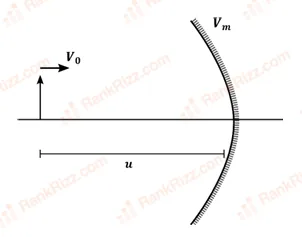
An object and a concave mirror of focal length cm both move along the principal axis of the mirror with constant speeds. The object moves with speed cm s towards the mirror with respect to a laboratory frame. The distance between the object and the mirror at a given moment is denoted by . When cm, the speed of the mirror is such that the image is instantaneously at rest with respect to the laboratory frame, and the object forms a real image. The magnitude of is _______ cm s.
SOLUTION
Let the pole of the mirror be the origin and the principal axis be the positive -axis directed towards the right. Hence distances measured towards the left are negative.
The focal length of a concave mirror is negative, so
At the instant of interest the separation between the object and the mirror is
With the sign convention this becomes
Using the mirror formula
Substituting and in (1):
Thus the image is formed in front of the mirror (real image, left side).
Let
be the mirror position, the object position, the image position (all in the laboratory frame).
Object speed (towards the mirror):
Mirror speed (to be found): (taken positive towards the right).
Signed object distance from the mirror is
Signed image distance from the mirror is . Differentiate the mirror formula with respect to time:
At the given instant and , so
Hence
The image position in the laboratory frame is
(because is measured from the mirror towards the left).
Therefore
The question states that the image is instantaneously at rest in the laboratory frame, so
Insert from above:
Multiply by 4:
The mirror must move rightwards with speed . Its magnitude is therefore 3 cm s, which satisfies the additional requirement that the image remains real.
Tagged Spherical mirrors: mirror formula and magnification. Machine-assigned, so read it as a strong shortlist rather than a verdict.