JEE Advanced 2021 Physics question — Prism: deviation and dispersion
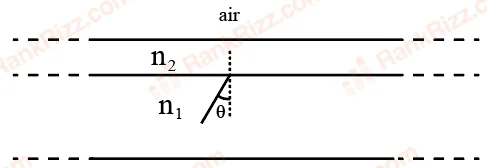
A wide slab consisting of two media of refractive indices and is placed in air as shown in the figure. A ray of light is incident from medium to at an angle , where is slightly larger than . Take refractive index of air as 1. Which of the following statement(s) is(are) correct?
SOLUTION
Let the refractive indices be arranged as
air (top, ) | medium | medium | air (bottom, ).
The ray starts inside and strikes the interface at an angle that satisfies
where is a very small positive number. Because , the ray would have suffered total internal reflection (TIR) if the medium outside had been air. We now examine what really happens in the presence of the layer.
Step 1: Refraction at the interface
Applying Snell’s law
Substituting gives
The second term in (1) is positive, so
Step 2: Incidence at the interface
The critical angle for the interface is defined by
Because from (1), the ray is definitely above the critical angle and therefore undergoes total internal reflection at the lower surface.
After reflection, it travels upward in medium with the same angle .
Step 3: Returning to the interface
When the ray coming from meets the boundary, its angle of incidence is again .
Whether is larger, equal to, or smaller than , Snell’s law gives
which has a real solution for because . Therefore total internal reflection cannot occur here; the ray always refracts back into medium .
Step 4: Meeting the upper interface
Inside the ray still makes the same angle with the normal.
Since the ray is again above the critical angle for the surface and is totally internally reflected.
Hence it remains trapped inside the slab, always coming back into the region.
Now check each statement:
Option A: If the two internal media are identical, but the analysis above still shows TIR at the lower air surface and again at the upper air surface. The ray never reaches air. False.
Option B: For , all steps above remain valid (because (1) was derived without assuming any ordering of ). The ray finally returns to medium . True.
Option C: For the same conclusion follows; the ray refracts back into after the lower TIR and is again reflected at the top surface. True.
Option D: If , the first interface itself is . Because , the ray is totally internally reflected immediately, i.e. it stays in . True.
Hence the correct statements are:
Option B, Option C and Option D.
Final Answer: Option B, Option C, Option D
Tagged Prism: deviation and dispersion. Machine-assigned, so read it as a strong shortlist rather than a verdict.