RankRizz
JEE ADVANCED 2021 · PAPER 1+3 / −1MEDIUMTRANSCRIBED

JEE Advanced 2021 Physics question — Combinations of lenses and mirrors

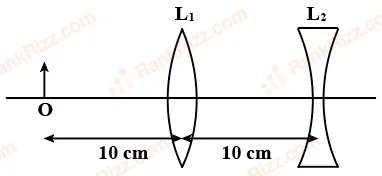
An extended object is placed at point O, 10 cm in front of a convex lens L1L_1 and a concave lens L2L_2 is placed 10 cm behind it, as shown in the figure. The radii of curvature of all the curved surfaces in both the lenses are 20 cm. The refractive index of both the lenses is 1.5. The total magnification of this lens system is

Figure for JEE Advanced 2021 Physics question on Combinations of lenses and mirrors
SOLUTION

The refractive index of each lens with respect to air is μ=1.5\mu = 1.5 and the radii of curvature of every curved surface are 20 cm20 \text{ cm}. For any thin lens in air the lens-maker formula is
1f=(μ−1)(1R1−1R2)\frac{1}{f} = (\mu-1)\left(\frac{1}{R_1}-\frac{1}{R_2}\right)

Convex lens L1L_1
For a symmetrical bi-convex lens, R1=+20 cmR_1 = +20 \text{ cm}, R2=−20 cmR_2 = -20 \text{ cm}.
1f1=(1.5−1)(120−1−20)=0.5(120+120)=0.5(110)=0.05\frac{1}{f_1}= (1.5-1)\left(\frac{1}{20}-\frac{1}{-20}\right) = 0.5\left(\frac{1}{20}+\frac{1}{20}\right) = 0.5\left(\frac{1}{10}\right)=0.05
⇒f1=20 cm\Rightarrow f_1 = 20 \text{ cm}

Concave lens L2L_2
For a symmetrical bi-concave lens, R1=−20 cmR_1 = -20 \text{ cm}, R2=+20 cmR_2 = +20 \text{ cm}.
1f2=(1.5−1)(1−20−120)=0.5(−120−120)=0.5(−110)=−0.05\frac{1}{f_2}= (1.5-1)\left(\frac{1}{-20}-\frac{1}{20}\right) = 0.5\left(-\frac{1}{20}-\frac{1}{20}\right) = 0.5\left(-\frac{1}{10}\right) = -0.05
⇒f2=−20 cm\Rightarrow f_2 = -20 \text{ cm}

Image formed by L1L_1
Object distance from L1L_1: u1=−10 cmu_1 = -10 \text{ cm} (negative because object is to the left).
Lens formula: 1v1−1u1=1f1\frac{1}{v_1}-\frac{1}{u_1}=\frac{1}{f_1}

1v1−1−10=120    ⟹    1v1=120−110=−120    ⟹    v1=−20 cm\frac{1}{v_1}-\frac{1}{-10}=\frac{1}{20} \;\;\Longrightarrow\;\; \frac{1}{v_1} = \frac{1}{20}-\frac{1}{10}= -\frac{1}{20} \;\;\Longrightarrow\;\; v_1 = -20 \text{ cm}

The image I1I_1 is therefore 20 cm to the left of L1L_1 (virtual and upright).
Linear magnification of L1L_1:
m1=v1u1=−20−10=2m_1 = \frac{v_1}{u_1}= \frac{-20}{-10}= 2

Object distance for L2L_2
The lenses are 10 cm apart, so the coordinate positions (taking L1L_1 at x=0x=0) are:
Object O at x=−10 cmx=-10\text{ cm}, image I1I_1 at x=−20 cmx=-20\text{ cm}, lens L2L_2 at x=+10 cmx=+10\text{ cm}.
Hence, for L2L_2 the object (which is I1I_1) lies 30 cm to its left:
u2=−30 cmu_2 = -30 \text{ cm}

Image formed by L2L_2
Using the lens formula for the concave lens:
1v2−1u2=1f2\frac{1}{v_2}-\frac{1}{u_2}=\frac{1}{f_2}

1v2−1−30=1−20    ⟹    1v2=−120−130=−560=−112    ⟹    v2=−12 cm\frac{1}{v_2}-\frac{1}{-30}=\frac{1}{-20} \;\;\Longrightarrow\;\; \frac{1}{v_2}= -\frac{1}{20}-\frac{1}{30}= -\frac{5}{60}= -\frac{1}{12} \;\;\Longrightarrow\;\; v_2 = -12 \text{ cm}

The final image I2I_2 is 12 cm to the left of L2L_2 (still on the left side of that lens).
Magnification produced by L2L_2:
m2=v2u2=−12−30=0.4m_2 = \frac{v_2}{u_2}= \frac{-12}{-30}=0.4

Total magnification of the lens system
m=m1×m2=2×0.4=0.8m = m_1 \times m_2 = 2 \times 0.4 = 0.8

Therefore, the total magnification is 0.8.

Option B which is: 0.8
Tagged Combinations of lenses and mirrors. Machine-assigned, so read it as a strong shortlist rather than a verdict.

SubjectPhysics
TopicCombinations of lenses and mirrors
TypeMultiple choice