JEE Advanced 2020 Physics question — Prism: deviation and dispersion
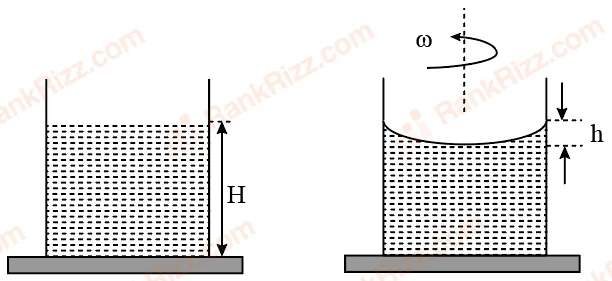
A beaker of radius 𝑟 is filled with water (refractive index ) up to a height 𝐻 as shown in the figure on the left. The beaker is kept on a horizontal table rotating with angular speed . This makes the water surface curved so that the difference in the height of water level at the center and at the circumference of the beaker is , as shown in the figure on the right. Take this surface to be approximately spherical with a radius of curvature 𝑅. Which of the following is/are correct? (g is the acceleration due to gravity)
SOLUTION
Key idea: in a rotating liquid the surface is a paraboloid, . Treat it as a spherical surface and use refraction at a curved surface.
- Radius of curvature (sagitta geometry): . So (A) is correct and (B) is not.
- Since : . With this gives .
- Apparent depth: light goes up from the bottom (in water, ) into air (). Take upward as positive: (using ). The surface is concave from above, so its centre of curvature is in air and . So the apparent depth is , which is (D).
Answer: (A), (D)
Tagged Prism: deviation and dispersion. Machine-assigned, so read it as a strong shortlist rather than a verdict.