JEE Advanced 2025 Physics question — Spring-block oscillations
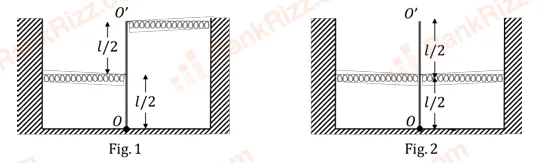
As shown in the figures, a uniform rod of length is hinged at the point and held in place vertically between two walls using two massless springs of same spring constant. The springs are connected at the midpoint and at the top-end () of the rod, as shown in Fig. 1 and the rod is made to oscillate by a small angular displacement. The frequency of oscillation of the rod is . On the other hand, if both the springs are connected at the midpoint of the rod, as shown in Fig. 2 and the rod is made to oscillate by a small angular displacement, then the frequency of oscillation is .
Ignoring gravity and assuming motion only in the plane of the diagram, the value of is:
SOLUTION
Let the mass of the rod be and its length be . It oscillates about the fixed hinge with a small angular displacement (taken positive for a clockwise rotation). Gravity is ignored, so only the springs give the restoring torque.
1. Moment of inertia about the hinge
For a uniform rod of length about one end,
2. Extension produced in a spring connected at distance from the hinge
When the rod rotates through a small angle , every point at a distance from the hinge moves through an arc of length perpendicular to the rod’s original position.
Hence the linear extension (or compression) of a spring attached at that point is also
3. Restoring torque of one spring
Spring force Torque about
Therefore each spring contributes a restoring torque equal to
4. Angular equation of motion
Sum of restoring torques
Hence
The linear frequency is so the ratio equals the ratio
Case 1: (Fig. 1)
Springs at and
Case 2: (Fig. 2)
Both springs at
5. Ratio of frequencies
Hence Option C is correct.
Tagged Spring-block oscillations. Machine-assigned, so read it as a strong shortlist rather than a verdict.