JEE Advanced 2022 Physics question — Biot-Savart law: straight wires and moving charges
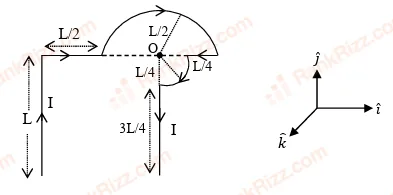
Which one of the following options represents the magnetic field at O due to the current flowing in the given wire segments lying on the plane?
SOLUTION
The magnetic field at any point is obtained by adding the contributions from each current-carrying segment separately.
For every straight segment lying in the -plane the field at the point O is perpendicular to the plane, i.e. along . We therefore have to calculate only the magnitudes and check the sign with the right-hand rule.
Magnetic field of a straight wire.
For an infinitely long straight wire at a perpendicular distance from the observation point,
.
Magnetic field of a finite straight wire.
For a straight piece of length the field at a point P lying at a perpendicular distance from the wire is
where and are the angles made by the lines PA and PB with the perpendicular from P to the wire.
The geometry given in the figure consists of two parts: (i) an infinitely long wire whose closest distance from O is , and (ii) a straight segment of length lying parallel to the -axis at a height above O, its right end being at . Both carry the same current .
(i) Field due to the infinitely long wire
Using the expression written above,
With the current direction shown in the figure, the right-hand rule gives the direction as .
(ii) Field due to the finite segment of length
For this segment the perpendicular distance from O is .
The nearer end of the segment lies directly above O, so and hence .
For the farther end at , the line joining it to O makes an angle of with the perpendicular; therefore .
Substituting these values in ,
The same right-hand rule shows that this field is also along .
Net magnetic field at O
Both contributions point along , so the magnitudes simply add:
Comparing with the given options, this is exactly Option C.
Option C which is:
Tagged Biot-Savart law: straight wires and moving charges. Machine-assigned, so read it as a strong shortlist rather than a verdict.