JEE Advanced 2014 Physics question — Newton's laws, free-body diagrams and equilibrium of a particle
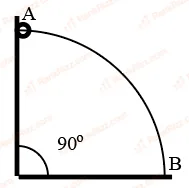
A wire, which passes through the hole in a small bead, is bent in the form of quarter of a circle. The wire is fixed vertically on ground as shown in the figure. The bead is released from near the top of the wire and it slides along the wire without friction. As the bead moves from A to B, the force it applies on the wire is
SOLUTION
Key idea: Apply Newton's law in the radial direction for the bead on the outside of the quarter circle. The normal force changes sign as the bead speeds up.
Let be the angle of the bead from the vertical, measured at the centre (the corner of the figure), and let be the wire's force on the bead, taken positive radially outward.
- Energy: .
- Radial equation (towards the centre):
- Near the top (), : the wire pushes the bead outward, so the bead pushes the wire inward.
- Once , : the wire pulls the bead inward, so the bead pushes the wire outward.
Answer: (D)
Tagged Newton's laws, free-body diagrams and equilibrium of a particle. Machine-assigned, so read it as a strong shortlist rather than a verdict.