JEE Advanced 2014 Physics question — Friction in multi-block systems
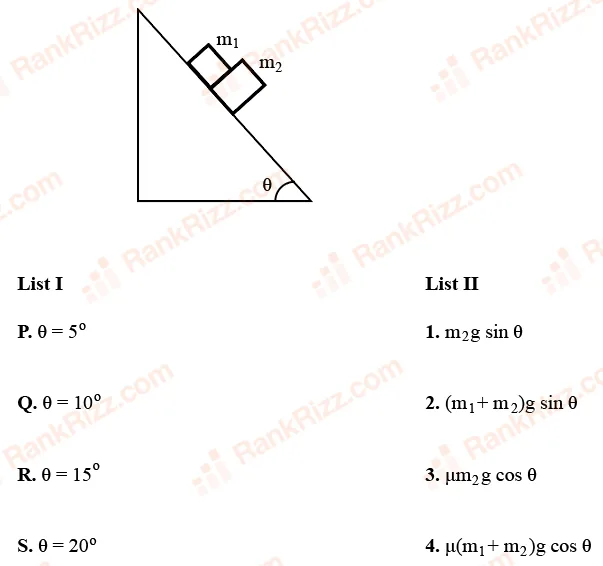
A block of mass another mass , are placed together (see figure) on an inclined plane with angle of inclination . Various values of are given in List I. The coefficient of friction between the block and the plane is always zero. The coefficient of static and dynamic friction between the block and the plane are equal to In List II expressions for the friction on block are given. Match the correct expression of the friction in List II with the angles given in List I, and choose the correct option. The acceleration due to gravity is denoted by g.
[Useful information :
Choices:
SOLUTION
Key idea: has no friction and pushes on , so friction on must hold both blocks. Static friction can reach at most .
- Force needed to hold the pair: .
- Maximum friction: .
- The blocks stay at rest if , i.e. , i.e. .
- P () and Q (): at rest, so static friction . This is List II 2.
- R () and S (): sliding, so kinetic friction . This is List II 3.
So P-2, Q-2, R-3, S-3.
Answer: (D)
Tagged Friction in multi-block systems. Machine-assigned, so read it as a strong shortlist rather than a verdict.