JEE ADVANCED 2012 · PAPER 1+4MEDIUMTRANSCRIBED
JEE Advanced 2012 Physics question — Motion on inclined planes and wedges
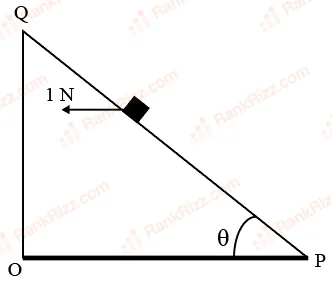
A small block of mass of 0.1 kg lies on fixed inclined plane PQ which makes an angle with the horizontal. A horizontal force of 1 N acts on the block through its center of mass as shown in the figure. The block remains stationary if (take g = 10 )
SOLUTION
Key idea: Resolve gravity and the horizontal 1 N force along the incline. Friction supplies whatever is left over.
- N. The incline rises from P to Q. The 1 N force points horizontally towards the vertical side OQ.
- Component of the applied force up the incline (towards Q): . Component of gravity down the incline (towards P): .
- Net force up the incline without friction: .
- : the net force is zero, so the block stays at rest with zero friction. (A) is correct.
- : , so the block tends to slide down towards P. Friction acts up the incline, towards Q. (C) is correct and (B) is wrong.
- : the block tends to move up, so friction acts towards P. (D) is wrong.
Answer: (A), (C)
Tagged Motion on inclined planes and wedges. Machine-assigned, so read it as a strong shortlist rather than a verdict.