JEE ADVANCED 2011 · PAPER 1EASYTRANSCRIBED
JEE Advanced 2011 Physics question — Newton's laws, free-body diagrams and equilibrium of a particle
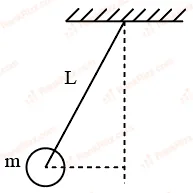
A ball of mass (m) 0.5 kg is attached to the end of a string having length (L) 0.5 m. The ball is rotated on a horizontal circular path about vertical axis. The maximum tension that the string can bear is 324 N. The maximum possible value of angular velocity of ball (in radian/s) is-
SOLUTION
Key idea: In a conical pendulum, the horizontal component of tension provides the centripetal force. This gives , independent of the cone angle.
- Let the string make angle with the vertical. The radius of the circle is .
- Horizontal: .
- Maximum at maximum tension:
Answer: (D)
Tagged Newton's laws, free-body diagrams and equilibrium of a particle. Machine-assigned, so read it as a strong shortlist rather than a verdict.