JEE Advanced 2021 Physics question — Vernier calipers: least count and zero error
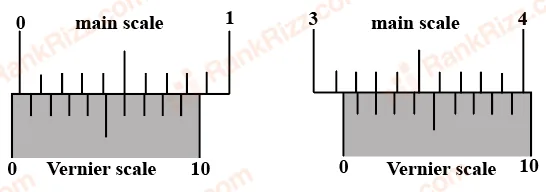
The smallest division on the main scale of a Vernier calipers is 0.1 cm. Ten divisions of the Vernier scale correspond to nine divisions of the main scale. The figure below on the left shows the reading of this calipers with no gap between its two jaws. The figure on the right shows the reading with a solid sphere held between the jaws. The correct diameter of the sphere is
SOLUTION
The main scale is calibrated in steps.
Ten Vernier‐scale (V-scale) divisions coincide with nine main-scale (M-scale) divisions, so
Total length of V-scale divisions .
Therefore one V-scale division .
The least count (LC) is the difference between one M-scale division and one V-scale division:
.
Zero error from the left-hand figure (jaws closed)
With the jaws in contact, the 0-mark of the V-scale is not aligned with the 0-mark of the M-scale.
It lies to the right of the M-scale zero.
The 3ᵗʰ Vernier division (counting from the zero) exactly coincides with a main-scale division.
Observed zero reading .
Because the zero of the V-scale is to the right of the M-scale zero, the zero error is positive .
Zero correction (to be applied to every measurement) .
Reading with the sphere between the jaws (right-hand figure)
1. Main-scale reading (MSR): the V-scale zero lies between the 3.1 cm and 3.2 cm marks, so .
2. Vernier coincidence: the 8ᵗʰ V-scale division coincides with a main-scale division, so additional reading .
3. Observed reading (before correction):
.
4. Apply the zero correction:
.
Hence the correct diameter of the sphere is .
Option C which is: 3.15 cm
Tagged Vernier calipers: least count and zero error. Machine-assigned, so read it as a strong shortlist rather than a verdict.