RankRizz
JEE ADVANCED 2023 · PAPER 2+4HARDTRANSCRIBED

JEE Advanced 2023 Physics question — Motional emf in moving rods and loops

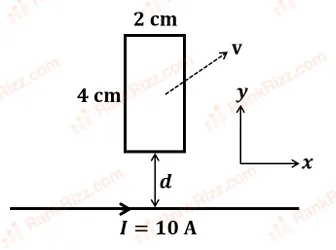
A rectangular conducting loop of length 4 cm and width 2 cm is in the xyxy-plane, as shown in the figure. It is being moved away from a thin and long conducting wire along the direction 32x^+12y^\frac{\sqrt{3}}{2}\hat{x} + \frac{1}{2}\hat{y} with a constant speed vv. The wire is carrying a steady current I = 10 A in the positive xx-direction. A current of 10 μ\muA flows through the loop when it is at a distance d=4d = 4 cm from the wire. If the resistance of the loop is 0.1 Ω\Omega, then the value of vv is ____ ms−1^{-1}.

[Given: The permeability of free space μ0=4π×10−7\mu_0 = 4\pi \times 10^{-7} NA−2^{-2}]

Figure for JEE Advanced 2023 Physics question on Motional emf in moving rods and loops
SOLUTION

Let the long straight wire coincide with the xx-axis and carry a steady current I=10 AI = 10 \, \text{A} in the +x^+\hat{x}-direction.
Hence the magnetic field produced by the wire at a point at distance rr from the wire (in the yy-direction) is

B=μ0I2πrB = \frac{\mu_0 I}{2\pi r}
and it is perpendicular to the xyxy-plane (along ±z^\pm \hat{z}).
Therefore the magnetic flux through a rectangular loop lying in the xyxy-plane depends only on its distance from the wire.

The rectangle has
length (side along yy) : l=4 cm=0.04 ml = 4 \, \text{cm} = 0.04 \, \text{m}
width (side parallel to the wire, along xx) : w=2 cm=0.02 mw = 2 \, \text{cm} = 0.02 \, \text{m}.

When the nearer edge of the loop is at a distance d=4 cm=0.04 md = 4 \, \text{cm} = 0.04 \, \text{m} from the wire, the farther edge is at d+l=0.04+0.04=0.08 md + l = 0.04 + 0.04 = 0.08 \, \text{m}.

The magnetic flux through the loop is

Φ=∫x=0w∫y=dd+lB(y) dy dx=wμ0I2π∫dd+ldyy=wμ0I2πln⁡ ⁣(d+ld).\Phi = \int_{x = 0}^{w} \int_{y = d}^{d+l} B(y)\, dy \, dx = w \frac{\mu_0 I}{2\pi}\int_{d}^{d+l}\frac{dy}{y} = w \frac{\mu_0 I}{2\pi}\ln\!\left(\frac{d+l}{d}\right).

The loop is pulled away from the wire with constant velocity
v⃗=v(32x^+12y^).\vec{v}=v\left(\frac{\sqrt{3}}{2}\hat{x}+\frac{1}{2}\hat{y}\right).
Only the yy-component changes the distance dd, so

dddt=vy=v2.\frac{dd}{dt}=v_y=\frac{v}{2}.

Induced emf (magnitude) is

E=∣dΦdt∣=wμ0I2π∣−ld(d+l)∣dddt=wμ0Il2πd(d+l)v2.\mathcal{E}= \left|\frac{d\Phi}{dt}\right| = w\frac{\mu_0 I}{2\pi}\left|\frac{-l}{d(d+l)}\right|\frac{dd}{dt} = w\frac{\mu_0 I l}{2\pi d(d+l)}\frac{v}{2}.

Using Ohm’s law, E=IRloop\mathcal{E}=IR_{\text{loop}}, where
induced current Iloop=10 μA=1.0×10⁻⁵ AI_{\text{loop}} = 10\,\mu\text{A}=1.0\times10^{-5}\,\text{A} and
resistance Rloop=0.1 ΩR_{\text{loop}} = 0.1\,\Omega.

Hence
E=IloopRloop=(1.0×10⁻⁵)(0.1)=1.0×10⁻⁶ V.\mathcal{E}=I_{\text{loop}}R_{\text{loop}} =(1.0\times10^{-5})(0.1) =1.0\times10^{-6}\,\text{V}.

Equating the two expressions for E\mathcal{E}:

1.0×10−6=wμ0Il2πd(d+l)v2.1.0\times10^{-6} = w\frac{\mu_0 I l}{2\pi d(d+l)}\frac{v}{2}.

Insert the numerical values:
w=0.02,  l=0.04,  d=0.04,  I=10,  μ0=4π×10−7.w = 0.02,\; l = 0.04,\; d = 0.04,\; I = 10,\; \mu_0 = 4\pi\times10^{-7}.

1.0×10−6=0.02(4π×10−7)(10)(0.04)2π(0.04)(0.08)v2.1.0\times10^{-6} = 0.02\frac{(4\pi\times10^{-7})(10)(0.04)}{2\pi(0.04)(0.08)}\frac{v}{2}.

Simplify:

1.0×10−6=0.02(4×10⁻⁷)(10)(0.04)2(0.04)(0.08)v21.0\times10^{-6} = 0.02\frac{(4\times10^{-7})(10)(0.04)}{2(0.04)(0.08)}\frac{v}{2}

1.0×10−6=0.02×4×10−7×10×0.042×0.04×0.08 v21.0\times10^{-6} = \frac{0.02\times4\times10^{-7}\times10\times0.04}{2\times0.04\times0.08}\,\frac{v}{2}

Evaluate the constant factor:
Numerator =0.02×4×10−7×10×0.04=3.2×10−9=0.02\times4\times10^{-7}\times10\times0.04=3.2\times10^{-9}
Denominator =2×0.04×0.08=6.4×10−3=2\times0.04\times0.08=6.4\times10^{-3}

Thus
1.0×10−6=(3.2×10−96.4×10−3)v2=5.0×10⁻⁷ v2.1.0\times10^{-6} =\left(\frac{3.2\times10^{-9}}{6.4\times10^{-3}}\right)\frac{v}{2} =5.0\times10^{-7}\,\frac{v}{2}.

Hence 1.0×10−6=2.5×10⁻⁷v1.0\times10^{-6}=2.5\times10^{-7}v
so v=1.0×10−62.5×10−7=4 m s−1.v = \frac{1.0\times10^{-6}}{2.5\times10^{-7}} = 4 \, \text{m\,s}^{-1}.

Therefore, the speed of the loop is
4 m s−1.

Tagged Motional emf in moving rods and loops. Machine-assigned, so read it as a strong shortlist rather than a verdict.

SubjectPhysics
TopicMotional emf in moving rods and loops
TypeNumerical answer