JEE Advanced 2021 Physics question — Motional emf in moving rods and loops
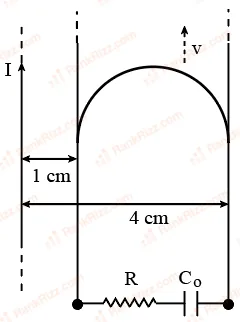
A long straight wire carries a current, I = 2 ampere. A semi-circular conducting rod is placed beside it on two conducting parallel rails of negligible resistance. Both the rails are parallel to the wire. The wire, the rod and the rails lie in the same horizontal plane, as shown in the figure. Two ends of the semi-circular rod are at distances 1 cm and 4 cm from the wire. At time t = 0, the rod starts moving on the rails with a speed v = 3.0 m/s (see the figure).
A resistor R = 1.4 Ω and a capacitor are connected in series between the rails. At time t = 0, is uncharged. Which of the following statement(s) is(are) correct?
SI units. Take
SOLUTION
The magnetic field produced by a long straight wire carrying current at a perpendicular distance is
Between the two parallel rails the distances from the wire are
When the semi-circular rod slides along the rails with speed , the loop area increases by in time . For an incremental displacement , the incremental flux is
Hence the induced emf (Faraday’s law ) has magnitude
The circuit now is a d.c. source of emf in series with a resistor and an initially uncharged capacitor .
Maximum current through (at )
Maximum charge on (after a long time)
In steady state the current becomes zero and the full emf appears across the capacitor:
Therefore the correct statements are:
Option A (Maximum current A),
Option C (Maximum charge C).
Option A and Option C are correct.
Tagged Motional emf in moving rods and loops. Machine-assigned, so read it as a strong shortlist rather than a verdict.