JEE ADVANCED 2008 · PAPER 1EASYTRANSCRIBED
JEE Advanced 2008 Physics question — Electric power and heating effect of current
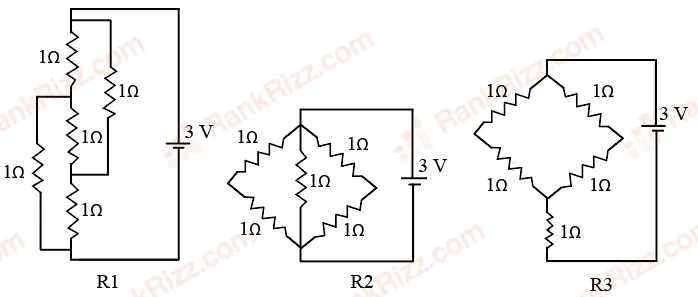
Figure shows three resistor configurations R1, R2 and R3 connected to 3 V battery. If the power dissipated by the configuration R1, R2 and R3 is P1, P2 and P3, respectively, then
SOLUTION
Key idea: with V, so the smallest equivalent resistance takes the most power.
- R1: The nodes are top T, middle nodes M1 and M2, and bottom B. The resistors are T–M1, M1–M2, M2–B, T–M2 (the right resistor) and M1–B (the left resistor), all 1 Ω. This is a balanced Wheatstone bridge (T–M1 = T–M2 and M1–B = M2–B). M1–M2 carries no current, so and W.
- R2: Between the top and bottom nodes are a 2 Ω path (left), a 1 Ω resistor (middle) and a 2 Ω path (right) in parallel. , so and W.
- R3: The diamond is two 2 Ω paths in parallel, giving 1 Ω, in series with 1 Ω. So and W.
- .
Answer: (C)
Tagged Electric power and heating effect of current. Machine-assigned, so read it as a strong shortlist rather than a verdict.