JEE Advanced 2023 Physics question — RC circuits: charging and discharging
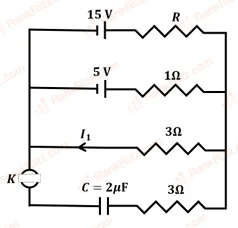
In a circuit shown in the figure, the capacitor is initially uncharged and the key is open. In this condition, a current of 1 A flows through the 1 resistor. The key is closed at time . Which of the following statement(s) is(are) correct?
[Given: ]
SOLUTION
Kirchhoff's laws and Thevenin's theorem determine circuit behavior during transient and steady-state conditions of a charging branch.
Given: (when is open), ,
At (Key open, bottom branch disconnected), using nodal analysis at the common right node relative to the left node ():
when is closed:
Evaluating capacitor branch current at ():
Evaluating steady-state charge ():
Answer: Option (A), Option (B), Option (C), Option (D)
Tagged RC circuits: charging and discharging. Machine-assigned, so read it as a strong shortlist rather than a verdict.