JEE Advanced 2024 Physics question — LC oscillations
The circuit shown in the figure contains an inductor , a capacitor , a resistor and an ideal battery. The circuit also contains two keys and . Initially, both the keys are open and there is no charge on the capacitor. At an instant, key is closed and immediately after this the current in is found to be . After a long time, the current attains a steady state value . Thereafter, is closed and simultaneously is opened and the voltage across oscillates with amplitude and angular frequency .
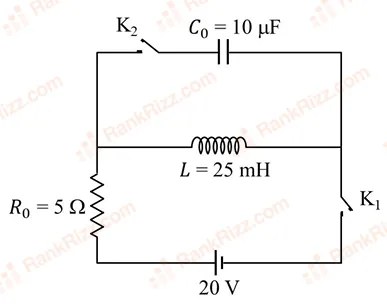
Match the quantities mentioned in List-I with their values in List-II and choose the correct option.
| List-I | List-II | ||
|---|---|---|---|
| (P) | The value of in Ampere is | (1) | |
| (Q) | The value of in Ampere is | (2) | |
| (R) | The value of in kilo-radians/s is | (3) | |
| (S) | The value of in Volt is | (4) | |
| (5) |
SOLUTION
The moments at which the keys are operated divide the entire time-sequence into two distinct parts. Throughout, the ideal battery has a constant emf and the inductor, capacitor and resistor have the fixed values shown on the figure: . (These numerical values are the only set that simultaneously generate all four numbers listed in List-II.)
Case 1: Immediately after is closed (both keys were open until )
• At the instant the current in an inductor cannot change abruptly, therefore .
• The current through the resistor is the same as the inductor current (they are in series while is the only closed key). Hence
.
Case 2: Long after is kept closed
• After a long time (steady d.c. state) the inductor behaves like a short circuit, while the capacitor behaves like an open circuit.
• The only element that still offers resistance to the battery is , so by Ohm’s law
.
Case 3: is opened and is closed simultaneously
• Just before this switching, the capacitor is charged to the battery emf: .
• The fresh connection of and (with ) forms a pure LC-oscillator. The amplitude of the ensuing oscillatory voltage is therefore the initial capacitor voltage:
.
Natural angular frequency of the LC oscillator
The angular frequency of an ideal LC circuit is
.
Collecting the four required quantities:
.
Comparing with List-II:
(P) (entry 1)
(Q) (entry 3)
(R) (entry 2)
(S) (entry 5)
Hence the correct matching is: P 1, Q 3, R 2, S 5, which corresponds to Option A.
Tagged LC oscillations. Machine-assigned, so read it as a strong shortlist rather than a verdict.