JEE Advanced 2022 Chemistry question — Reactions of alkynes
The number of isomeric tetraenes (NOT containing sp-hybridized carbon atoms) that can be formed from the following reaction sequence is _______.
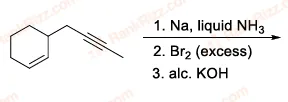
SOLUTION
Na in liquid reduces the internal triple bond to a trans double bond, giving 3-[(E)-but-2-en-1-yl]cyclohexene; the ring C=C is not affected.
Excess adds to both C=C bonds, giving 1,2-dibromo-3-(2,3-dibromobutyl)cyclohexane: Br on ring C1 and C2 (C3 carries the side chain) and on side-chain C2 and C3, .
Alcoholic KOH removes four HBr by E2. A product without sp carbon can contain neither nor , so each Br-bearing carbon must form its double bond with a neighbour that loses only an H.
In the ring this allows only C1=C6 (Br of C1 with H of C6) and C2=C3 (Br of C2 with the H of C3); forming C1=C2 would leave a vinylic Br whose removal gives an allene.
In the side chain this allows only C1=C2 (Br of C2 with H of C1) and C3=C4 (Br of C3 with H of the ); forming C2=C3 would lead to an alkyne or an allene.
The only tetraene constitution is therefore 1-(buta-1,3-dien-1-yl)cyclohexa-1,3-diene, .
The ring double bonds are held cis by the ring, the terminal shows no geometrical isomerism and there is no stereocentre; only the side-chain C1=C2 bond (ring and H on one carbon, vinyl and H on the other) exists in E and Z forms.
The isomeric tetraenes are (E)- and (Z)-1-(buta-1,3-dien-1-yl)cyclohexa-1,3-diene.
Hence, the answer is 2.
Tagged Reactions of alkynes. Machine-assigned, so read it as a strong shortlist rather than a verdict.