JEE Advanced 2020 Chemistry question — Reactions of alkynes
Consider the following transformations of a compound P.
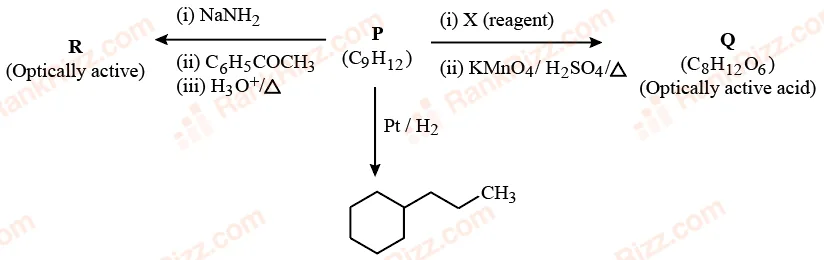
Choose the correct option(s).
SOLUTION
P, , has degrees of unsaturation, and /Pt gives propylcyclohexane, so P is a cyclohexane ring with a three-carbon chain and three π bonds in all.
P reacts with and then adds to acetophenone, so it is a terminal alkyne: the chain is (two π bonds) and the remaining π bond is a C=C in the ring.
X must reduce only the bond, giving ; over Pd-C poisoned with quinoline does this, so (B) is correct. Hot acidic then cleaves to and , and opens the ring C=C into two groups, leaving 8 carbons.
With the ring double bond at C2–C3 (option C), Q is , . Its CH carbon carries H, , and , so Q is chiral and optically active: (C) is correct.
With the ring double bond at C3–C4 (option A), Q is , whose CH carbon carries two identical groups, so Q is achiral: (A) is wrong.
For R, the acetylide of P adds to and /heat dehydrates the tertiary propargylic alcohol to , with the ring double bond still at C2–C3, next to the ring CH. The structure in (D) has the ring double bond at C3–C4, so (D) is wrong.
Hence, the correct options are (B) and (C).
Tagged Reactions of alkynes. Machine-assigned, so read it as a strong shortlist rather than a verdict.