JEE ADVANCED 2015 · PAPER 2+4 / −2MEDIUMTRANSCRIBED
JEE Advanced 2015 Chemistry question — Reactions of alkynes
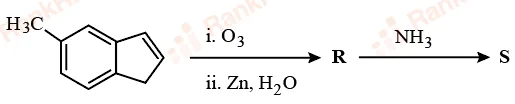
In the following reactions, the product S is
SOLUTION
Key idea: Ozonolysis of the five-membered ring double bond in indene gives an aryl aldehyde plus an aryl-acetaldehyde on adjacent ring carbons. then closes both carbonyls into a pyridine ring, giving an isoquinoline.
- In the starting indene, the bond is cleaved by / Zn–:
- C3 becomes an directly on the ring carbon C3a.
- C2 becomes the of a group on C7a (the old stays). R = 2-(2-formylaryl)acetaldehyde, which carries the methyl.
- With , both C=O groups condense with one N (two imine/enamine formations, then loss of 2 ). This builds an aromatic ring: CH=N–CH=CH. The result is isoquinoline: C1 comes from the aryl-CHO, C3 from the acetaldehyde C=O, and C4 from the .
- Tracking the methyl: it is para to the ring carbon carrying the (which becomes C4a) and meta to the carbon carrying the vinyl CH (which becomes C8a). That position is C7 of isoquinoline.
- S = 7-methylisoquinoline, i.e. option (A). (B) and (D) are quinolines, and (C) has the methyl at C6.
Answer: (A)
Tagged Reactions of alkynes. Machine-assigned, so read it as a strong shortlist rather than a verdict.