JEE Advanced 2015 Chemistry question — Electrophilic addition to alkenes
In the following reaction, the major product is
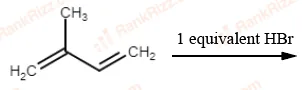
SOLUTION
Isoprene, , takes up at the terminal carbon C-1 (next to the methyl-bearing carbon), because this gives the most stable cation, one that is both tertiary and allylic:
Both the 1,2- and the 1,4-adduct come from this same cation. at C-2 gives the 1,2-adduct (option B); at C-4 gives the 1,4-adduct (option D).
The 1,4-adduct has a trisubstituted C=C, while the 1,2-adduct has only a monosubstituted terminal C=C. The tertiary allylic bromide ionises easily back to the same allylic cation, so the mixture equilibrates to the more stable 1,4-adduct, 1-bromo-3-methylbut-2-ene, which is the major product.
Option (A), 3-bromo-2-methylbut-1-ene, needs protonation at C-4 through the less stable secondary allylic cation; option (C), 4-bromo-2-methylbut-1-ene, is an anti-Markovnikov product that ionic addition does not give.
Hence, the correct option is (D).
Tagged Electrophilic addition to alkenes. Machine-assigned, so read it as a strong shortlist rather than a verdict.