JEE ADVANCED 2011 · PAPER 2EASYTRANSCRIBED
JEE Advanced 2011 Chemistry question — Reactive intermediates and rearrangements
The total number of contributing structures showing hyperconjugation (involving C-H bonds)for the following carbocation is
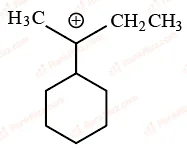
SOLUTION
Key idea: Each C–H bond on a carbon directly attached to the cationic carbon (an α-C–H) gives one hyperconjugative structure.
- The cation is . The positive carbon has three neighbours.
- Count the α-hydrogens:
- : 3 H
- of ethyl: 2 H
- ring CH of cyclohexyl (the attachment carbon): 1 H
- Total α-H , so there are 6 hyperconjugative structures. (The neutral classical structure is not counted.)
Answer: 6
Tagged Reactive intermediates and rearrangements. Machine-assigned, so read it as a strong shortlist rather than a verdict.