JEE ADVANCED 2015 · PAPER 1+4 / −2MEDIUMTRANSCRIBED
JEE Advanced 2015 Chemistry question — Diazonium salts
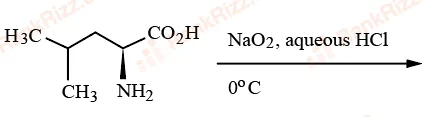
The major product of the reaction is
SOLUTION
Key idea: Diazotisation of an α-amino acid (/HCl; "NaO" is a misprint) replaces by with retention of configuration. The neighbouring carboxylate takes part, giving two inversions.
- The neighbouring attacks the carbon bearing from the back and pushes out . This forms an α-lactone (first inversion).
- Water then opens the α-lactone at the same carbon, again by backside attack (second inversion).
- Net result: two inversions = retention. The OH takes the position of (wedge), and the is kept.
- Product: (S)-2-hydroxy-4-methylpentanoic acid with OH on a wedge, option (C).
- (A) and (D) wrongly lose the carboxylic acid.
- (B) shows inversion.
Answer: (C)
Tagged Diazonium salts. Machine-assigned, so read it as a strong shortlist rather than a verdict.