JEE MAIN 2024 · 09 APR S2Geometric progression and infinite GPTRANSCRIBED
Let be an infinite G.P. If and , then is equal to
- A
46
- B
38
- C
31
- D
27
Every Sequences and Series question JEE Main has set, grouped by the idea it tests rather than the order of the syllabus. 337 questions across 8 distinct ideas. Free to read, answer key on every one.
Questions
337
Distinct ideas
8
Share of marks
7.1%
Difficulty
HARD
A chapter is not one subject — it is a handful of procedures the examiner reuses. These are the ones Sequences and Series questions actually test.
81–100 OF 337 · NEWEST FIRST
Let be an infinite G.P. If and , then is equal to
46
38
31
27
Let the first three terms 2, p and q, with q ≠ 2, of a G.P. be respectively the 7th, 8th and 13th terms of an A.P. If the term of the G.P. is the term of the A.P., then n is equal to:
Let be in A.P. and be in G.P. Then, the arithmetic mean of , and is:
If each term of a geometric progression with and , is the arithmetic mean of the next two terms and , then is equal to
Let 2, 8 and 44, terms of a non-constant A.P. be respectively the 1, 2 and 3 terms of G.P. If the first term of A.P. is 1 then the sum of first 20 terms is equal to
980
960
990
970
Let be an equilateral triangle. A new triangle is formed by joining the middle points of all sides of the triangle and the same process is repeated infinitely many times. If is the sum of perimeters and is be the sum of areas of all the triangles formed in this process, then :
A software company sets up number of computer systems to finish an assignment in 17 days. If 4 computer systems crashed on the start of the second day, 4 more computer systems crashed on the start of the third day and so on, then it took 8 more days to finish the assignment. The value of is equal to:
Let and be two arithmetic progressions. Then the sum of the common terms in them is equal to:
If three successive terms of a G.P. with common ratio (r > 1) are the length of the sides of a triangle and denotes the greatest integer less than or equal to r, then is equal to:
If , then the value of is _______.
Let upto terms and . If , then is equal to _______.
If upto , where and are integers with , then is equal to ______
Let be in an arithmetic progression of positive terms. Let . If and , then is equal to ______
Let the first term of a series be and its term , . If the sum of the first terms of this series is , then is equal to ______
If , , and , where , then equal to ___________
Let the positive integers be written in the form:
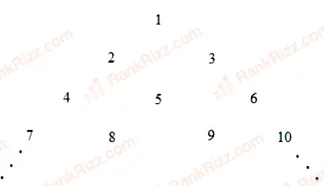
If the row contains exactly numbers for every natural number , then the row in which the number 5310 will be, is ________
An arithmetic progression is written in the following way:
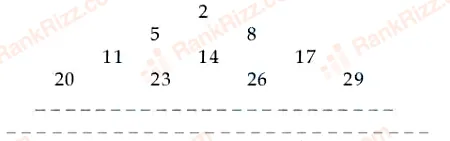
The sum of all the terms of the row is _____
If , then is equal to ________
Let be the sum to n-terms of an arithmetic progression , if 40 < \frac{6}{n(n+1)}\sum_{k=1}^{n} S_k < 42, then equals ____________.
Let respectively be the sum of 12 terms of 10 A.P.s whose first terms are and the common differences are respectively. Then is equal to
OTHER MATHS CHAPTERS