JEE MAIN 2021 · 27 AUG S2Random variables, mean and varianceTRANSCRIBED
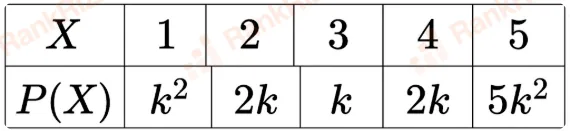
The probability distribution of random variable is given by

Let p = P(1 < X < 4 | X < 3). If , then is equal to _________.
Every Probability question JEE Main has set, grouped by the idea it tests rather than the order of the syllabus. 251 questions across 9 distinct ideas. Free to read, answer key on every one.
Questions
251
Distinct ideas
9
Share of marks
4%
Difficulty
MEDIUM
A chapter is not one subject — it is a handful of procedures the examiner reuses. These are the ones Probability questions actually test.
161–180 OF 251 · NEWEST FIRST
The probability distribution of random variable is given by
Let p = P(1 < X < 4 | X < 3). If , then is equal to _________.
An electric instrument consists of two units. Each unit must function independently for the instrument to operate. The probability that the first unit functions is 0.9 and that of the second unit is 0.8. The instrument is switched on and it fails to operate. If the probability that only the first unit failed and second unit is functioning is , then is equal to _________.
Let there be three independent events and . The probability that only occurs is , only occurs is and only occurs is . Let '' denote the probability of none of events occurs that satisfies the equations and . All the given probabilities are assumed to lie in the interval . Then, is equal to ________.
Let be a random variable with distribution.

If the mean of is 2.3 and variance of is , then is equal to _________.
If 10 different balls are to be placed in 4 distinct boxes at random, then the probability that two of these boxes contain exactly 2 and 3 balls is:
An unbiased coin is tossed 5 times. Suppose that a variable X is assigned the value k when k consecutive heads are obtained for , otherwise X takes the value . Then the expected value of X, is
In a box, there are 20 cards, out of which 10 are labelled as and the remaining 10 are labelled as . Cards are drawn at random, one after the other and with replacement, till a second card is obtained. The probability that the second card appears before the third card is:
A die is thrown two times and the sum of the scores appearing on the die is observed to be a multiple of 4. Then the conditional probability that the score 4 has appeared at least once is
A random variable has the following probability distribution:
Then, P(X > 2) is equal to:
The probability that a randomly chosen 5-digit number is made from exactly two digits is:
In a workshop, there are five machines and the probability of any one of them to be out of service on a day is . If the probability that at most two machines will be out of service on the same day is , then is equal to
4
Box 1 contains 30 cards numbered 1 to 30 and Box 2 contains 20 cards numbered 31 to 50. A box is selected at random and a card is drawn from it. The number on the card is found to be a non-prime number. The probability that the card was drawn from Box 1 is:
Out of 11 consecutive natural numbers if three numbers are selected at random (without repetition), then the probability that they are in A.P. with positive common difference is:
Let A and B be two independent events such that and . Then, which of the following is true?
Let denote the complement of an event . Let , and be any pairwise independent events with P(E_1) > 0 and then is equal to:
The probabilities of three events A, B and C are given , and . If , , , and , where , then lies in the interval:
In a game two players A and B take turns in throwing a pair of fair dice starting with player A and total of scores on the two dice, in each throw is noted. A wins the game if he throws a total of 6 before B throws a total of 7 and B wins the game if he throws a total of 7 before A throws a total of six. The game stops as soon as either of the players wins. The probability of A winning the game is:
Let and , be two events such that the probability that exactly one of them occurs is , and the probability that or , occurs is , then the probability of both of them occur together is.
0.02
0.20
0.01
0.10
Four fair dice are thrown independently 27 times. Then the expected number of times, at least two dice show up a three or a five, is
In a bombing attack, there is 50% chance that a bomb will hit the target. At least two independent hits are required to destroy the target completely. Then the minimum number of bombs, that must be dropped to ensure that there is at least 99% chance of completely destroying the target, is.....
OTHER MATHS CHAPTERS