JEE MAIN 2021 · 16 MAR S2Monotonicity and intervals of increase/decreaseTRANSCRIBED
Let be a real valued function, defined on and given by . Then in which of the following intervals, function is increasing?
- A
- B
- C
- D
Every Applications of Derivatives question JEE Main has set, grouped by the idea it tests rather than the order of the syllabus. 250 questions across 9 distinct ideas. Free to read, answer key on every one.
Questions
250
Distinct ideas
9
Share of marks
2%
Difficulty
HARD
A chapter is not one subject — it is a handful of procedures the examiner reuses. These are the ones Applications of Derivatives questions actually test.
101–120 OF 250 · NEWEST FIRST
Let be a real valued function, defined on and given by . Then in which of the following intervals, function is increasing?
The sum of all the local minimum values of the twice differentiable function defined by is:
-22
5
-27
0
The function is such that . Consider two statements:
: there exists , , such that and .
: there exists , , such that is decreasing in , increasing in and . Then
is true and is false
both and are false
both and are true
is false and is true
The triangle of maximum area that can be inscribed in a given circle of radius 'r' is:
An equilateral triangle having each of its side of length .
An isosceles triangle with base equal to .
An equilateral triangle of height .
A right angle triangle having two of its sides of length and .
If the tangent to the curve at the point meets the curve again at , then the ordinate of the point which divides internally in the ratio 1 : 2 is:
0
A wire of length 20 m is to be cut into two pieces. One of the pieces is to be made into a square and the other into a regular hexagon. Then the length of the side (in meters) of the hexagon, so that the combined area of the square and the hexagon is minimum, is
Let be a matrix, where
Let a function be defined as . Then the sum of maximum and minimum values of on is equal to:
If Rolle's theorem holds for the function , with , then ordered pair is equal to:
An angle of intersection of the curves, and , , is:
Consider the function defined by . Then is:
monotonic on
not monotonic on and
monotonic on only
monotonic on only
Let be defined as
Then is increasing function in the interval
Let , . Then, is:
increasing in
decreasing in
increasing in
decreasing in
Let be a real number such that the function , is increasing in and decreasing in . Then the function , has a
local maximum at
local minimum at
local maximum at
local minimum at
The shortest distance between the line and the curve is:
0
Let be any continuous function on and twice differentiable on . If , and , then:
f''(x) > 0 for all
for some
for some
for all
The local maximum value of the function, , , is:
1
The number of real roots of the equation is:
0
1
4
2
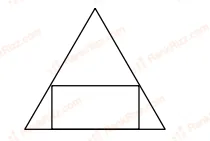
If a rectangle is inscribed in an equilateral triangle of side length as shown in the figure, then the square of the largest area of such a rectangle is _________.
If is the least value of such that the function is increasing on and is the greatest value of such that the function is decreasing on , then the value of is _________.
The maximum value of in the following equation , where and for and is ________.
OTHER MATHS CHAPTERS