JEE MAIN 2019 · 10 APR S1Distance, foot and image with respect to a planeTRANSCRIBED
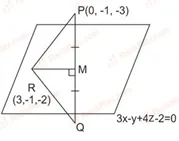
If Q(0, -1, -3) is the image of the point P in the plane and R is the point (3, -1, -2), then the area (in sq. units) of is
- A
- B
- C
- D
Every Three Dimensional Geometry question JEE Main has set, grouped by the idea it tests rather than the order of the syllabus. 409 questions across 9 distinct ideas. Free to read, answer key on every one.
Questions
409
Distinct ideas
9
Share of marks
6.9%
Difficulty
HARD
A chapter is not one subject — it is a handful of procedures the examiner reuses. These are the ones Three Dimensional Geometry questions actually test.
321–340 OF 409 · NEWEST FIRST
If Q(0, -1, -3) is the image of the point P in the plane and R is the point (3, -1, -2), then the area (in sq. units) of is
The equation of the plane containing the straight line and perpendicular to the plane containing the straight lines and is:
If a point lies on the line segment joining the points and , then the distance of R from the origin is:
6
A perpendicular is drawn from a point on the line to the plane such that the foot of the perpendicular Q also lies on the plane . Then the coordinates of Q are
(2, 0, 1)
(-1, 0, 4)
(4, 0, -1)
(1, 0, 2)
The plane passing through the point and parallel to the lines and also passes through the point:
The perpendicular distance from the origin to the plane containing the two lines, and , is
11
If the line, meets the plane, at a point P, then the distance of P from the origin is:
If the line intersects the plane at a point P and the plane at a point Q, then PQ is equal to
14
On which of the following lines lies the point of intersection of the line, and the plane, ?
Let P be the plane, which contains the line of intersection of the planes, and and it is perpendicular to the xy-plane. Then the distance of the point (0, 0, 256) from P is equal to:
units
units
units
units
The sum of the intercepts on the coordinate axes of the plane passing through the point (-2, -2, 2) and containing the line joining the points (1, -1, 2) and (1, 1, 1) is:
4
12
-8
-4
If is the line of intersection of the planes , and is the line of intersection of the planes , , then the distance of the origin from the plane, containing the lines and is:
An angle between the lines whose direction cosines are given by the equations, and , is:
If the angle between the lines and is , then P is equal to:
A variable plane passes through a fixed point (3, 2, 1) and meets x, y and z axes at A, B and C respectively. A plane is drawn parallel to yz-plane through A, a second plane is drawn parallel zx plane through B and a third plane is drawn parallel to xy-plane through C. Then the locus of the point of intersection of these three planes, is:
The length of the projection of the line segment joining the points (5, -1, 4) and (4, -1, 3) on the plane, is:
A plane bisects the line segment joining the points (1, 2, 3) and (-3, 4, 5) at right angles. Then this plane also passes through the point:
(-3, 2, 1)
(3, 2, 1)
(1, 2, -3)
(-1, 2, 3)
An angle between the plane, and the line of intersection of the planes, and , is:
If the image of the point in the plane, measured parallel to the line, is , then is equal to:
The coordinates of the foot of the perpendicular from the point on the plane containing the lines and , is:
OTHER MATHS CHAPTERS