Gravitation
PHYSICS · 7 IDEAS · 225 PAST QUESTIONS · JEE MAIN + ADVANCED · 2004–2026
HOW TO USE THIS SHEET
One past question per idea, most-asked idea first; each is the most recent time the examiner set it. Answer it cold. Check your answer at the address printed beside it — there is no key in this sheet. An idea here is one syllabus topic — the finest tag our past questions carry. A topic can hold more than one technique, so treat each question as the door into an idea, not the whole of it.
- 01Acceleration due to gravity and its variationset 59×
When one moves from a point 16 km below the earth's surface to a point 16 km above the earth's surface. The change in g is approximately %. The value of is _______. (Take radius of the earth = 6400 km.)
- (A)
- (B)
- (C)
- (D)
CHECK IT: rankrizz.com/jee-main/physics/gravitation/q/5-apr-2026-s1-q28
- (A)
- 02Kepler's laws and planetary motionset 53×
A particle of mass , and angular momentum is moving in a circular orbit of radius under the influence of an attractive force . Keeping its angular momentum unchanged, the particle is displaced radially by a small distance , due to which its radial distance varies periodically. The corresponding time period is:
- (A)
- (B)
- (C)
- (D)
CHECK IT: rankrizz.com/jee-advanced/physics/gravitation/q/2026-paper-2-q4
- (A)
- 03Escape speedset 44×
If a body of mass 1 kg falls on the earth from infinity, it attains velocity and kinetic energy on reaching the surface of earth. The values of and respectively are ______.
(Take radius of earth to be 6400 km and m/s)- (A)
km/s; J
- (B)
km/s; J
- (C)
km/s; J
- (D)
km/s; J
CHECK IT: rankrizz.com/jee-main/physics/gravitation/q/2-apr-2026-s2-q31
- (A)
- 04Satellites: orbital speed, period, energy and geostationary orbitsset 30×
Given below are two statements:
Statement I : A satellite is moving around earth in the orbit very close to the earth surface. The time period of revolution of satellite depends upon the density of earth.
Statement II: The time period of revolution of the satellite is (for satellite very close to the earth surface), where radius of earth and g acceleration due to gravity.In the light of the above statements , choose the correct answer from the options given below:
- (A)
Both Statement I and Statement II are true
- (B)
Statement I is true but Statement II is false
- (C)
Statement I is false but Statement II is true
- (D)
Both Statement I and Statement II are false
CHECK IT: rankrizz.com/jee-main/physics/gravitation/q/22-jan-2026-s2-q43
- (A)
- 05Gravitational potential energy of systemsset 26×
A body of mass is taken from the surface of the earth to a height equal to twice the radius of earth. The increase in potential energy will be :
(g is acceleration due to gravity at the surface of earth)- (A)
- (B)
- (C)
- (D)
CHECK IT: rankrizz.com/jee-main/physics/gravitation/q/5-apr-2026-s2-q32
- (A)
- 06Gravitational field and potential of rings, shells and spheresset 11×
A metal wire of uniform mass density having length L and mass M is bent to form a semicircular arc and a particle of mass m is placed at the centre of the arc. The gravitational force on the particle by the wire is:
- (A)
- (B)
- (C)
- (D)
CHECK IT: rankrizz.com/jee-main/physics/gravitation/q/04-apr-2024-s1-q7
- (A)
- 07Newton's law of gravitation and superpositionset 2×
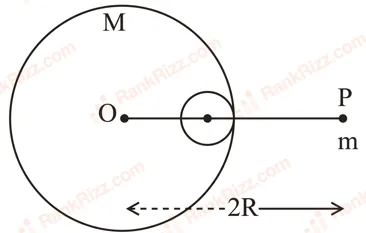
A small point of mass m is placed at a distance 2R from the centre 'O' of a big uniform solid sphere of mass M and radius R . The gravitational force on 'm' due to M is . A spherical part of radius R/3 is removed from the big sphere as shown in the figure and the gravitational force on m due to the remaining part of M is found to be . The value of ratio is
- (A)
12 : 11
- (B)
11 : 10
- (C)
12 : 9
- (D)
16 : 9
CHECK IT: rankrizz.com/jee-main/physics/gravitation/q/22-jan-2025-s1-q35
- (A)
Past questions are reproduced with their sitting. Not affiliated with NTA or the IITs. Every question on each idea: rankrizz.com/jee-main/physics/gravitation